Local Culture in Curaçao: Willemstad Beyond the Postcard Row
Updated September 24, 2026 · 7 min read
Everyone photographs the same thing in Willemstad: the row of tall gabled merchant houses along the Handelskade, painted ochre, blue and green, reflected in the water. It is a genuinely beautiful street and it takes about four minutes.
The city behind it is a UNESCO World Heritage site, and it earned that listing for something less photogenic — four historic districts of Dutch colonial architecture adapted to the tropics, built on the profits of a trading and slaving port, still standing and still lived in. Punda and Otrobanda face each other across the harbour mouth; Scharloo and Pietermaai sit behind them.
Here is what is actually worth your time in it.
The bridge that moves out of the way
The Queen Emma Bridge is a pontoon bridge across St Anna Bay linking Punda and Otrobanda. It dates from 1888, it floats on a line of pontoons, and when a ship needs to enter the harbour, one end unhitches and the whole bridge swings aside with people still on it.
It is free to cross. When it stays open for a long passage, a free ferry runs instead, so you are never stranded on the wrong side — but you may well be stranded on the bridge itself while it moves, which is the best two minutes of the day.
Walk it at night as well as in daylight. The painted facades are lit, and the crowd changes completely.
The synagogue with sand on the floor
In Punda, a few streets back from the water, stands Mikvé Israel-Emanuel. The congregation was founded in 1651 and the building completed in 1732, which makes it the oldest synagogue in the Americas still in continuous weekly use.
The floor is covered in sand. The usual explanation is that Sephardic Jews on the Iberian peninsula spread sand to muffle the sound of prayers during persecution, and the practice travelled with them. Whatever weight you give the story, standing in a working synagogue with sand underfoot is not an experience available in many places.
Across the courtyard there is a Jewish Cultural Historical Museum, entry around $10, and you will be asked for valid photo ID at the door — bring it rather than walking back to the hotel. Shabbat services are held Friday evening and Saturday morning; if you visit then, you are a guest at a service, not a tourist at a monument.
Kurá Hulanda: the part of the history the waterfront does not tell
In Otrobanda, on a site that was once used in the slave trade, Museum Kurá Hulanda documents the transatlantic slave trade and African heritage in the Caribbean. It opened in 1999 and it is not a light hour.
It is the necessary counterweight to the rest of the old town. Willemstad’s beautiful buildings were paid for by a particular commerce, and this museum is where the island says so directly. Opening hours are given as Monday to Saturday 8 am to 4 pm and Sunday 9 am to 2 pm — worth confirming before you go, as they have changed in the past.
Papiamentu, and the four words to learn
Curaçao’s own language is Papiamentu — a creole built on a Portuguese and Spanish base with Dutch, African and some Arawak in it, spoken here as a first language and official alongside Dutch and English. Spelled with a u on Curaçao; Aruba writes it with an o.
Nobody expects you to speak it. Using four words changes how a conversation starts:
- Bon bini — welcome
- Bon dia — good morning
- Danki — thank you
- Ayó — goodbye
You will see Bon Bini on signs everywhere. It is not marketing language; it is the actual word.
The liqueur distillery, with the prices straight
Landhuis Chobolobo is where Senior Curaçao liqueur is made, in a country house in the city. The blue colour is a dye — the flavour comes from the dried peel of the laraha, a bitter orange descended from Spanish stock that adapted to this dry island and became something unusable as fruit but excellent as peel.
- Open Monday to Friday, 8:00 am to 5:00 pm.
- Guided tours at 9, 10 and 11 am and at 1, 2 and 3 pm — no weekend tours.
- Standard tour: 60 minutes, USD 20, including tastings and one cocktail or a soft drink.
- Deluxe tour: 60 minutes, USD 30, with two drinks and a scoop of locally made ice cream.
- Cocktail workshop: about 120 minutes, USD 50, where you make two of them yourself.
- Children under 13 join free; from 13 they need a ticket. Alcohol is served from 18. For the workshop, 15- to 17-year-olds may take part with parental consent.
- Free cancellation up to 24 hours ahead; arrive 15 minutes early for a tour, 30 for the workshop.
If you would rather have it built into a morning, a city, culture and Blue Curaçao tasting tour takes 2 hours 30 minutes at €57.10 with hotel pickup, and a Willemstad highlights tour with the liqueur factory and a beach stop runs 4 hours at €34.26.
Which walking tour, and why
There are 35 Willemstad city tours from €12.99 — the lowest starting price anywhere in our inventory, which the broader things to do category matches exactly. Two stand out on the numbers.
The highlights walking tour with a local guide is 2 hours 30 minutes at €19.68 and holds 4.7 stars from 272 people. For under twenty euros and a morning, it is the single best-value thing in this article.
The colourful history walking tour is shorter and dearer — 2 hours at €32.50, 4.6 stars from 168 — and crosses both banks on foot, from the Rif Fort to the markets and a rum distillery.
Why pay for a guide in a town you could walk yourself? Because the buildings do not explain themselves. The gables, the galleries, the colour rule, whose money built which house, why Otrobanda looks different from Punda — none of that is on a plaque. A guided walk here buys information, not access.
Two things to see that cost nothing
The floating market in Punda, where boats from Venezuela have long tied up to sell produce, is a working market with a real history and an uncertain present — its size varies considerably with the political and economic situation across the water. Go and see what is there rather than what a photograph promised.
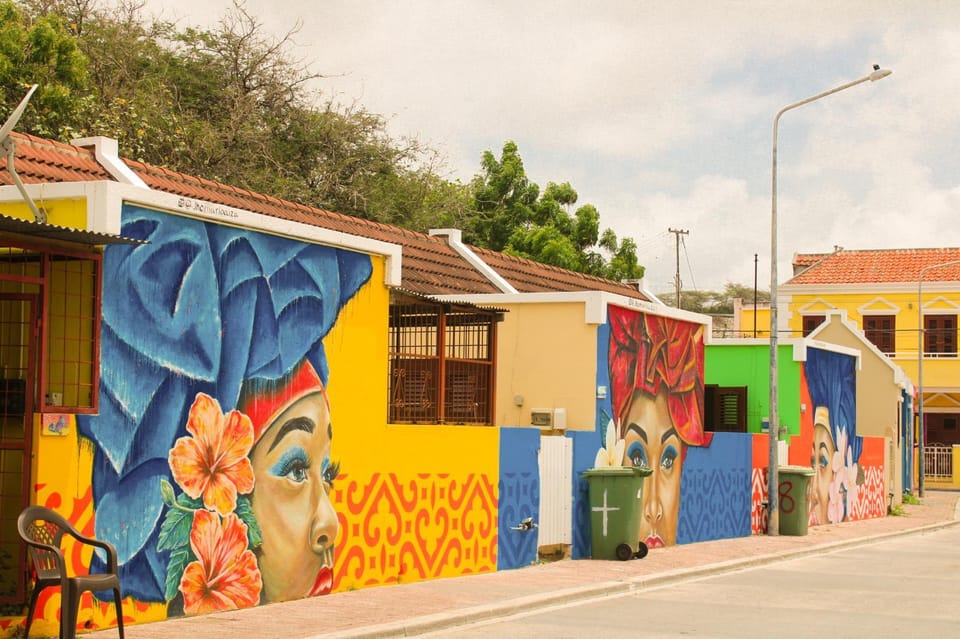
And the murals of Otrobanda and Pietermaai. Whole streets of houses are painted, several storeys high, and they are the most alive thing in the old city. They are also the reason a guided walk pays off: somebody has to tell you who painted what and why.
For the rest of the island’s list — beaches, boats, caves and the west end — start with what to do in Curaçao or the nature spots.