Curaçao's Nature Spots: Opening Times That Catch People Out
8 min read
Curaçao’s landscape is dry. Not disappointing — dry. Thorn scrub, columnar cactus, divi-divi trees bent flat by the trade wind, and limestone terraces stepping down to the sea. It looks nothing like the rainforest islands further east, and once you stop expecting that, it is one of the more interesting places in the Caribbean to spend a morning on foot.
The word morning is doing real work in that sentence. Almost every mistake visitors make here is a timing mistake, so the hours come first.
Christoffelpark: ticket sales end before closing
The island’s large national park sits at the western end, around the 372-metre Christoffelberg. It has walking and driving routes through the scrub, and the Savonet Museum in a restored plantation house at the entrance.
- The park’s Opening Hours & Fees page gives daily hours of 6 am to 3 pm, with ticket sales ending at 1:30 pm. Its FAQ and regulations also contain a 2 pm closing time and an instruction to leave before 1:30 pm. Confirm the required exit time with the park before planning a late visit.
- The Savonet Museum keeps shorter hours: 6 am to 2 pm.
- Admission is $15 for adults and $2 for children aged 6 to 12, with under-sixes free. Groups of 15 or more pay $9 each.
- You can start climbing Christoffel Mountain from 6 am, and the latest permitted start is 10 am — because of the heat, not the daylight.
That last rule is the one that ruins plans. The park describes the mountain trail as strenuous and recommends hiking shoes, sun protection and two litres of water per person; an early start gives you more time before the heat builds. People arrive at eleven expecting to walk up a hill and are turned away, correctly.
Guided mountain climbs and a two-hour safari tour are available on request through the park; contact activities@carmabi.org to arrange them.
Shete Boka: the coast that does not want you in it
On the north coast, adjoining Christoffelpark, Shete Boka protects a run of bokas — inlets where waves drive into the limestone. At Boka Tabla you walk down into a cave under the cliff and stand in the noise while the sea slams into the chamber below you.
- Open every day, 8 am to 4 pm, with no admittance after 3 pm.
- $15 for adults, $2 for children 6 to 12, under-sixes free. These regular hours and admission fees are published on Shete Boka’s visitor page.
This is also a nesting coast. The park says three sea turtle species nest along this coast, with a nesting season running approximately from May to December. Its conservation information explains why the breeding inlets are protected. That is the park’s own statement, and it is the reason the inlets are protected rather than developed.
Do not swim here. The water in the bokas is not rough in the way a lively beach is rough; it is a different thing entirely.
The Hato Caves: check the step count before you go
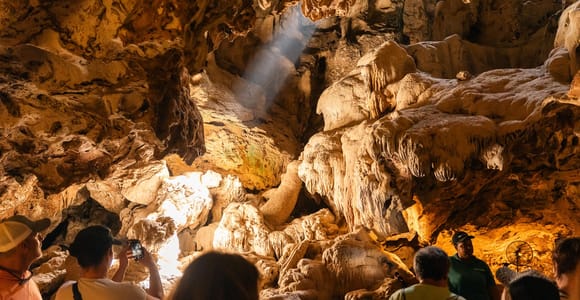
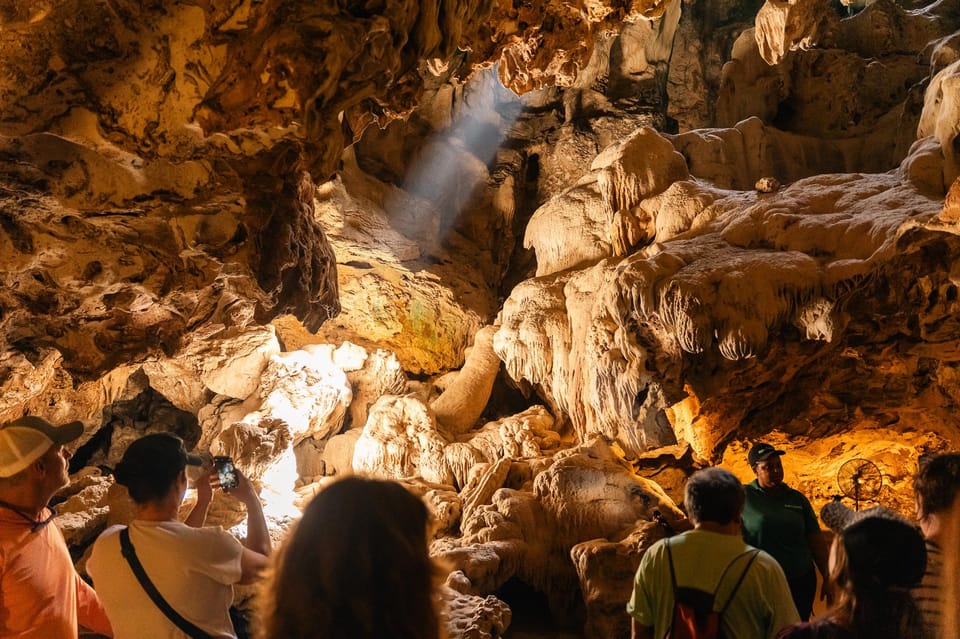
A limestone cave system near the airport, with stalactites, flowstone and a colony of bats.
- Guided tours leave every full hour, the first at 9 am and the last at 3 pm, and you are welcome from about 8:50 am. Arrive at least ten minutes before your chosen departure. Buy direct admission on arrival; tour operators also sell packages online. The cave FAQ warns that special-day hours can change.
- USD 10 for non-resident adults and USD 8 for children aged 4 to 12, according to the cave operator’s price list.
- The guided tour lasts a maximum of 50 minutes, with walking trails outside taking another 30 or so. The FAQ gives the outdoor trail hours as 9 am to 2:45 pm, so those trails cannot be added after the 3 pm cave tour.
- The operator’s homepage says tours run in English, with Dutch, Spanish and Papiamentu on request via WhatsApp.
And the practical part: the FAQ counts 48 steps to the entrance, while the homepage says 49. The caves are not wheelchair accessible. The FAQ describes the tour as not suitable for people with medical conditions and most suitable for children aged four and up. Plan on climbing the entrance staircase; the cave visit is not a wheelchair-accessible alternative.
The flamingos at Jan Kok
The salt pans at Jan Kok, near the village of Sint Willibrordus, are a place to look for wild flamingos on Curaçao; sightings depend on the birds. The tourism board places the pans beside the road to Sint Willibrordus and describes an observation tower next to the Williwood sign.
Two things make the difference between a good stop and a bad photograph. Go early or late if you prefer low light for photographs. And keep your distance and follow any signs on site: these are wild birds in a feeding ground, and a flock that lifts off because somebody walked closer has not been seen, it has been disturbed.
The old plantation house at Jan Kok nearby now houses an art gallery, which makes the stop worth more than ten minutes.
Do you need a car for any of this?
A car gives you control over the order and timing, but it is not essential for every stop.
Central Willemstad can be explored on foot; for beaches and nature stops beyond your base, arrange a bus, taxi, tour or rental car. Christoffelpark, Shete Boka and the west end require transport planning around their opening hours. Compare a taxi quote for your route with the full cost of a rental car or guided tour. The 51 island tours from €31.89 offer another way to organise a sightseeing day; choose by the actual stops and pickup area.
Where the car wins is the timing. With your own transport, you can aim for Christoffelpark’s early opening and arrange the rest of the day around each site’s hours. If you want to compare what hiring one actually costs before deciding, you can compare rental cars for Curaçao — and if the answer is that a driver for one day is cheaper, take the tour instead.
Check the access route and current road conditions for each stop. Before taking an unpaved beach track, check whether your rental agreement permits it and whether the vehicle has sufficient clearance.
The guided versions, and what they actually cover
A half-day trip to the Hato Caves, the flamingos and Kokomo Beach runs 4 hours at €61.96 per person with 4.5 stars from 136 reviews. It includes transport from Willemstad, a guide, bottled water and entry fees. The itinerary allows 75 minutes at Hato Caves, a 15-minute flamingo photo stop and 90 minutes at Kokomo. It is listed as not suitable for people with mobility impairments or wheelchair users.
A full day taking in the Hato Caves, a turtle snorkel stop, Kenepa and the flamingos is 6 hours at €61.51 per person, with 423 reviews and 4.4 stars. It includes return transport from Willemstad and is listed as not suitable for non-swimmers, people with mobility impairments or wheelchair users. The itinerary gives Kenepa one hour, while the description says two; confirm the beach time before choosing it for a long swim. For both tours, the pickup confirmation can arrive up to 24 hours before departure; the pages describe a pickup window between 8 and 9 am. For the six-hour tour, ask the operator which listed items—cave admission, snorkel equipment, drinks, meals and beach chairs—are covered by your selected ticket.
Both itineraries combine Hato Caves with beach and flamingo stops; plan Christoffelpark and Shete Boka as separate visits. If those two are what you came for, consider driving yourself or discussing the route and an early start with a private-tour provider — 37 offers, from €59.23.
When to come
The Curaçao Meteorological Department places the dry season from February through May. The same climate summary gives the rainy season as October through January. Curaçao lies on the southern edge of the Atlantic hurricane region. The weather service describes direct impacts as relatively rare compared with islands farther north; the Atlantic hurricane season runs from 1 June to 30 November.
Whatever the month, plan for heat and check the forecast before hiking or visiting the exposed coast. Start early for Christoffelpark, and fit the other stops to their own opening times.