Animals in Curaçao: Turtles, Flamingos and the Dolphin Question
Updated September 24, 2026 · 7 min read
Curaçao makes this easy in a way that is almost a trap. Wild turtles gather at a known beach. Flamingos stand beside a public road. And a large marine park in town will let you hold onto a dolphin’s fin for a photograph.
Those three things are not the same kind of experience, and it is worth being clear about which is which before you book anything.
Turtles at Playa Piskadó: go, but understand what you are joining
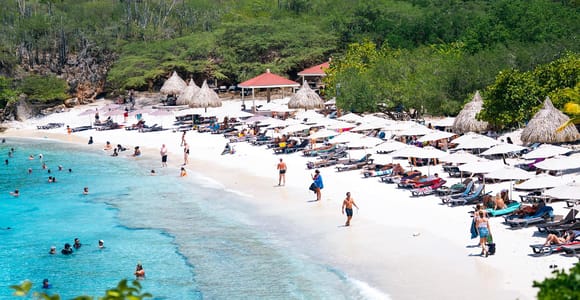
Playa Piskadó — the signs also say Playa Grandi — sits at the far west end of the island. Piskadó is Papiamentu for fisherman, and that is what the beach is: a working landing where boats come in and the catch is cleaned at the pier.
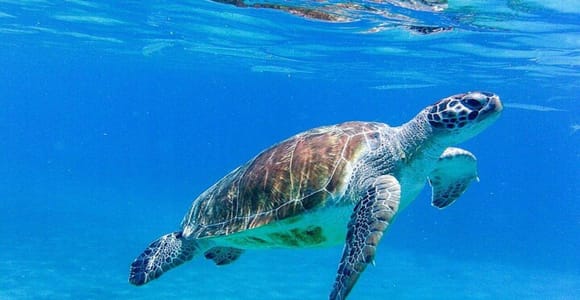
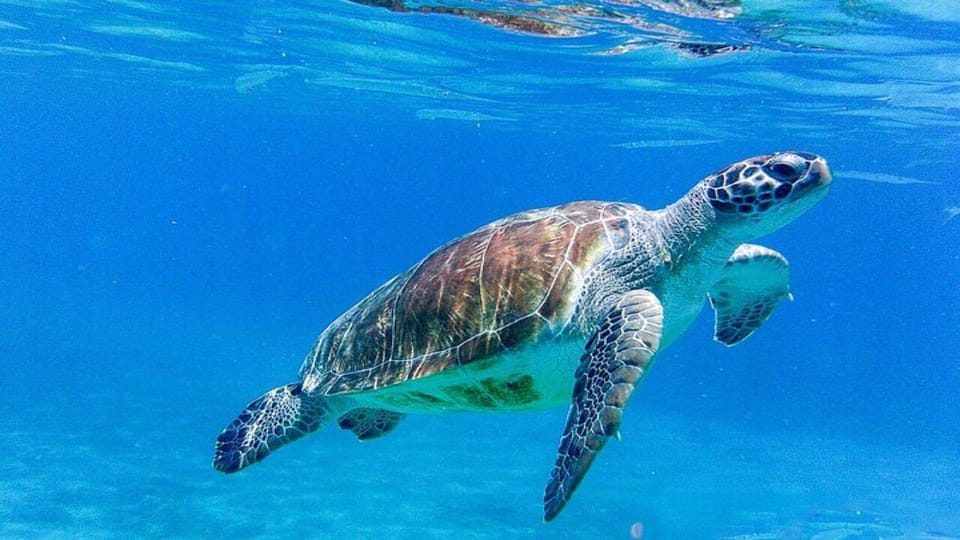
Green turtles learned that fish scraps enter the water there, and they come for them. Which means you will very probably see turtles, close, from the surface, without a boat. It also means the sighting is not quite wild. It is a habit the animals formed around human waste.
That has consequences the beach is now living with. Conservationists on the island report that some turtles have begun to avoid Playa Piskadó, and the specific practice they have objected to is people being charged for photo opportunities while fish waste is thrown in to draw the animals closer.
All marine turtles occurring in Curaçao have complete legal protection — set out in the island decree on the protection of sea turtles of 19 June 1996, made under the island’s reef management ordinance. This is not a guideline aimed only at tour operators. It applies to whoever is in the water.
So, the rules:
- Do not touch. A turtle’s shell carries a protective layer that a hand damages, and physical contact stresses an animal that cannot easily get away from you.
- Do not feed, and do not pay anybody who offers to bring them closer.
- Do not chase, corner or ride. A turtle that changes direction because of you is a turtle you have disturbed.
- Leave it a clear path to the surface. They breathe air. Floating above one is the single most common mistake.
- Stay off the fishermen’s pier. It is a workplace, not a viewing platform.
- No flash.
None of that stops you seeing them. It mostly means holding still and letting the animal decide the distance — which, as it happens, is also how you get the better look.
Other places turtles turn up without the crowd: Playa Lagun, Playa Kalki and the reef edges along the west coast. Fewer guarantees, better encounters. The 56 snorkelling trips from €43.92 include several with a turtle stop, and where to walk in without any of them is covered in snorkelling from the shore.
A guided snorkel with turtles and Kenepa Grandi beach runs 4 hours at €65.88 with 4.7 stars and includes the flamingo sanctuary, and a top-three-beaches tour with a turtle snorkel takes 4 hours at €55.56.
Nesting: a different season, a different coast
The turtles you snorkel with on the west coast are feeding. The ones that nest do it at night on the north coast, in the pocket bays of Shete Boka National Park — and that park exists largely to protect them.
Three species lay eggs there: hawksbill, loggerhead and green turtle. The park gives the nesting season as running approximately from May to December.
If you are in the park during those months, the rule is simply to stay off the sand in the bokas and out of any marked area. A nest is invisible and a tyre track or a footprint in the wrong place is enough.
Flamingos, and how close is too close
The salt pans at Jan Kok, near Sint Willibrordus, are the reliable spot. The pans lie beside the road with a small watchtower and no car park — you park on the verge and walk.
Two things make the visit work. Come early in the morning or late in the afternoon, when the light is low and the birds are feeding rather than standing out the midday heat. And keep to the distances marked on the signs. Flamingos are nervous feeders; a flock that takes off is not a photo opportunity, it is a flock that has stopped eating.
Binoculars do more for this stop than any camera lens most people travel with.
The dolphins: what is actually on offer, and the argument about it
The Dolphin Academy, part of the Curaçao Sea Aquarium, keeps bottlenose dolphins in a saltwater lagoon and sells swim, snorkel and dive encounters with them. We list one: a dolphin snorkel experience of 1 hour 35 minutes at €184.47, rated 4.9 by 12 people.
We are not going to pretend the debate does not exist, so here it is from both sides.
The facility’s position is that the dolphins live in a natural seawater lagoon, that the programmes are educational and enriching for the animals as well as the guests, and that they form part of a managed breeding programme.
The objection is that a lagoon divided into linked pens is still an enclosure the animals cannot leave; that trained behaviours performed for paying guests — fin rides, “kisses”, tricks — are entertainment rather than natural behaviour; and that animals which cannot be released should at least not be exhibited for profit. Tripadvisor does not sell tickets to this attraction, on the stated grounds that it does not meet the site’s animal welfare guidelines. That is a checkable fact about a large booking platform’s policy, and it is the clearest single signal available to someone deciding.
Our position is the plain one: people rate the experience itself very highly, and the ethical question is a separate matter that reviews do not answer. If holding a wild-species animal in an enclosure for a paid encounter is something you are not comfortable with, this is that, and the enthusiasm of previous guests does not change it. If you book it, book it knowing.
What you can do instead, in the same water: the SeaWorld Explorer semi-submarine shows the reef and its fish through hull windows for 1 hour at €34.26, and a guided underwater walk puts you on the seafloor in a weighted helmet for 1 hour at €118.59, 4.7 stars from 209 people, with no swimming ability needed. Neither involves an animal being asked to perform.
The ostrich farm
There is an ostrich farm on the road to Groot Sint Joris in the east, open daily from 9 am to 4 pm with tours running roughly every hour. It is a working farm rather than a sanctuary, with a restaurant that serves ostrich. Ticket prices are quoted differently in different places, so ask the farm rather than trusting a listing — including ours.
Of the 45 island tours from €24.60 we list exactly one that goes there: a 2½-hour round of an aloe farm, an ostrich safari and the Chobolobo distillery, at €92.23 — a single review so far, so there is nothing to go on but the itinerary. The other 44 skip it, so if you want the farm, either book that one or drive out yourself.
The one rule that covers all of it
The animals here are not exhibits with an admission price, whatever some of them are being sold as. Watch, keep your distance, feed nothing, touch nothing, and let the animal set how close the encounter gets. It is better wildlife watching, and on a small island where the same beach gets the same visitors every single day, it is the only version that still works in ten years.
For the rest of what the island offers on land, see nature spots in Curaçao.